

Cracks run both down the center of the road and across the road on this stretch of Murrieta Road north of Scott Road. (Staff photo)
Although an infrastructure group’s survey indicated that 69 percent of Menifee’s paved roads are rated in “very good” or “excellent” condition, the Menifee Public Works Department acknowledges that much work must be done to improve the city’s overall road conditions.


Public Works Director Nick Fidler gave an update on the city’s pavement management program to the City Council at its Feb. 4 meeting. The study, conducted by Bucknam Infrastructure Group, analyzed the approximately 397 centerline miles of paved roads using the Pavement Condition Index. The PCI is used to measure roadway conditions on a scale from 0 (failed pavement) to 100 (new or recently rehabilitated pavement).
The current citywide overall PCI is 75.1, which is in the “very good” range. But Fidler acknowledged that in order to improve the 30 percent of the roads that are below that mark – and to maintain all roads — much more funding than has previously been allocated will be needed.
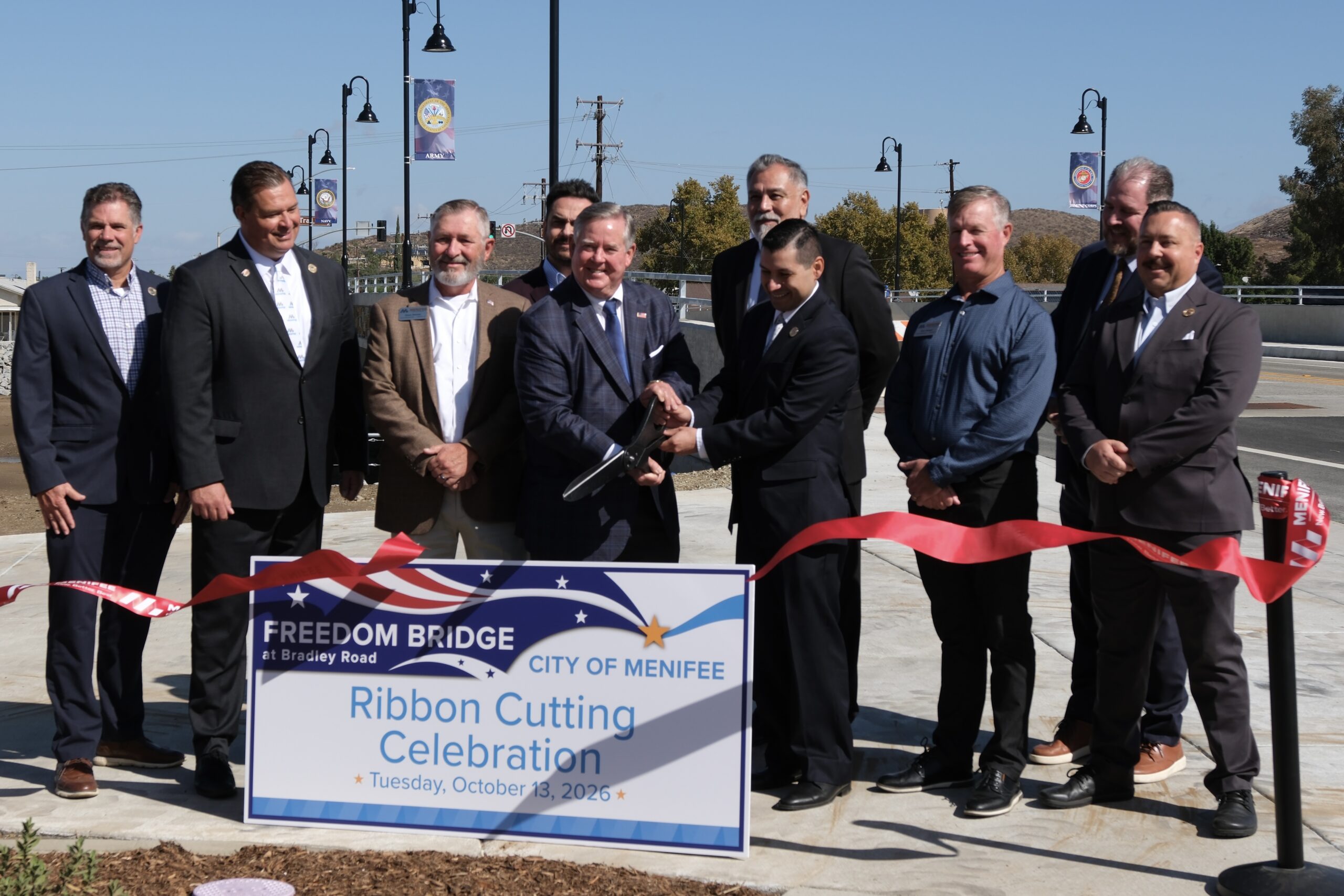
Fidler’s presentation to the council stated that the city has spent an average of $4 million per year on pavement maintenance over the last five years, “while prioritizing larger capital investments focused on traffic mitigation” projects, including new traffic signals, roadway widening projects, the Holland Road overpass ($32 million) and Bradley Road Bridge ($21 million).
The report made it clear that a focus on improving standard paved roads throughout the city is necessary. Just in order to maintain the city’s PCI of 75, it is estimated that the city would need about $10.6 million annually – or $53.5 million over the next five years. Even then, “deferred maintenance” — postponing necessary repairs or maintenance because of budget constraints — is currently $49.2 million and is projected to increase to $62.8 million by 2029-30.
Simply put, a major increase in funding is required just to keep up with the worst of the road maintenance needs.
“Without sustained investment, deferred maintenance would continue to increase, resulting in higher long-term costs and greater impacts to public safety and mobility,” the staff report to the City Council stated. “Staff are actively pursuing multiple funding sources, including Community Facilities Districts, which collect dedicated neighborhood-level [tax] revenue but require time to accumulate sufficient reserves to fund pavement maintenance projects.
“Additional citywide sources such as Gas Tax, Measure A, and Measure DD may be used to support larger resurfacing and rehabilitation projects. A combined approach using both local and citywide funding sources is recommended to create a stable and sustainable pavement funding strategy.”
Those numbers caused concern for council member Dean Deines, who spent his career as a budget analyst for Riverside County.
“I’m concerned about the rising cost of deferred maintenance,” Deines said. “Things are deteriorating faster than we’re rebuilding.”
“We’re looking at funding sources to close that gap,” Fidler responded.
Deines also referred to wear and tear from large trucks on city roads and asked whether it was possible to restrict the trucks to certain roads.
“We try to make them stick to a few major roads,” Fidler replied.
Acting Mayor Bob Karwin also expressed concern.
“In Sun City, roads are breaking apart in the middle, even though on the outside, they’re in fine condition,” he said. “There are layers of slurry seal on either side of the cracks, but the cracks are major.”
Karwin also referred to a stretch of Murrieta Road from Craig Avenue south to Scott Road (Bundy Canyon Road).
“On the map, that road is given a green (good) rating,” Karwin said. “I don’t what they’re using to come up with that. I’m not sure what the criteria is when it’s like you’re off-roading on some of these roads.”
Referring to the road there, Fidler said, “The rideability is horrible, but structurally it’s sound. We’ve been grinding out the seams. We have a couple options; we can use microplanning to put a tip seal over the top and protect the cracks from letting water in.”
The staff report also states that the city has begun resurfacing projects in four of the most critical areas:
— Local AC Resurfacing: Approximately 1.25 centerline miles of roadway total, including approximately .25 centerline miles of residential and 1 centerline mile of major roadways, all of which have a current PCI of less than 70.
— Slurry Seal Project: Approximately 2.26 centerline miles of roadway. Slurry Seal in bidding phase.
— Mapes Road Resurfacing: 2,600 cubic feet (.25 centerline miles). Project in the design phase.
— Antelope Road Resurfacing: Approximately 6,600 cubic feet (1.25 centerline miles) for a total of 6.3 centerline miles. Project in the design phase.
In addition, the Riverside County Annual Resurfacing project includes four roadway segments within the City limits:
— Lindenberger Road/Scott Road to 2,154 feet south of the intersection.
— MenifeeRoad/Scott Road to 2,611 feet south of the intersection.
— Scott Road / Menifee Road to Lindenberger Road.
— Briggs Road from Highway 74 to McLaughlin Road.
These projects are in addition to larger Capital Improvement Projects, including the McCall Boulevard/215 Interchange; Scott Road/Bundy Canyon Road widening; and Holland Road widening from Bradley Road to Haun Road – all in the design phase.
 Large cracks such as this one on Murrieta Road are seen in several locations around the city. (Staff photo)