

The Perris Union High School District Board of Trustees reorganized its leadership at the Dec. 10 board meeting. Edward Garcia was selected as the new board president, Jamie Anaya as vice president, Anthony T. Stafford as clerk, and Charles Hall as the district’s representative to the County Committee on School District Organization.
After the annual organizational items, the board moved through a full agenda that included the district’s First Interim Financial Report and continued discussion of walk-through weapons detection systems.


Assistant Superintendent of Business Services Marguerite Williams presented the First Interim Financial Report, which covers financial activity from July 1 through Oct. 31, 2025.
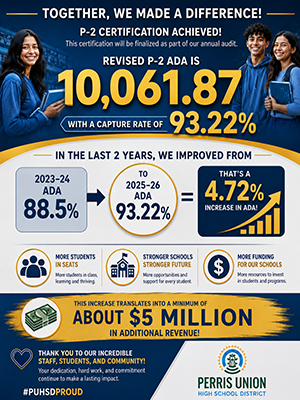
She told trustees the district is recommending a positive certification, meaning PUHSD is projected to meet all financial obligations this year and for the next two years. Enrollment increased by 141 students, and average daily attendance rose from 90.34 percent to 90.65 percent, both contributing to stronger revenue than previously budgeted.
The district’s total revenue increased by $3.78 million this year, helped in part by $2.4 million in unused safety funds that were returned to PUHSD. The district also started the year with $6.8 million more in its beginning balance than expected after its annual audit. At the same time, expenses rose by $6 million, mainly because of salary increases and associated benefit costs. Even with those added expenses, PUHSD still expects to finish the year with a $5.26 million increase to its ending fund balance and will continue to meet its required 6 percent reserve.
While the district’s finances look stable for this year, Williams warned the board that the long-term outlook is more challenging. According to the district’s multi-year projections, spending is expected to rise faster than revenue beginning in 2026–27. If that trend continues, the district’s savings, or ending fund balance, would fall to about $17.4 million by 2027–28.
Trustees also discussed staffing, noting that 18 teachers are currently working in non-classroom roles at a cost of $3.3 million. Several board members asked for a detailed list of those positions and a broader review of administrative staffing, emphasizing that any future reductions should avoid the classroom. District staff said they plan to bring additional information to the Budget Advisory Committee early next year.
Later in the meeting, the board revisited its ongoing evaluation of walk-through weapons detection systems for district high schools. The discussion follows a special meeting in November where representatives from Evolv Technology and CEIA USA presented different screening systems.
Staff shared updated cost comparisons and logistics, noting that Evolv’s system would cost about $476,999 in its first year with ongoing annual support fees and would require routing students through a single entry point at each school.
CEIA units cost significantly less per scanner but require far more units to cover all campuses, bringing total costs to roughly $508,313. Staffing costs for the systems would vary depending on whether schools use full-day or partial shifts, which would affect the overall total cost.
Staff also reminded the board that any purchase of a system would need to follow state bidding requirements or rely on a valid cooperative contract. Because of that, the board did not select a specific vendor. Instead, they unanimously agreed to gather more information before deciding how best to move forward with weapons detection systems.
Surveys will be distributed to parents and staff early next year to gather feedback and reactions to metal detectors on campus. The results will help guide the board’s next steps.