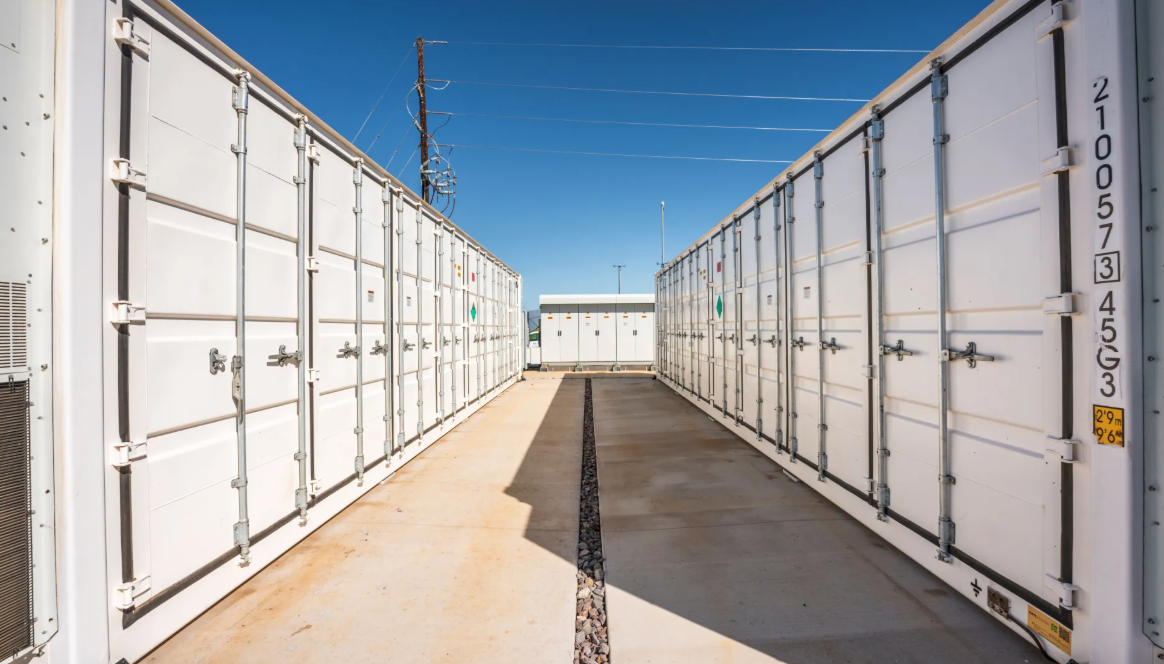



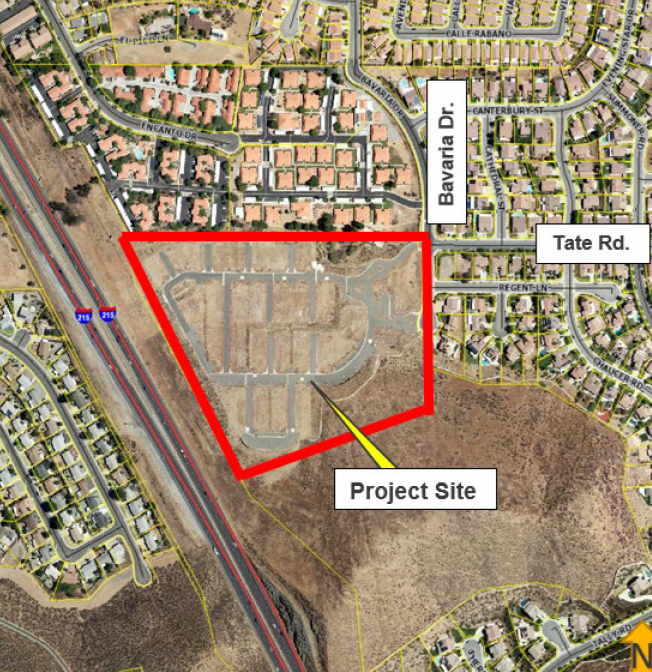

Battery storage containers like this will be placed in the new Menifee facility. (Photo via AES website)
The Menifee Planning Commission last week unanimously approved plans for a second battery energy storage facility in northeast Menifee.


The Double Butte Battery Energy Storage System will be located on a 27-acre site between Matthews Road and McLaughlin Road, next to the Nova Power Bank battery storage facility that was constructed in 2024.
According to the staff report for the project, the facility will be a 500-megawatt energy storage system for lithium ion phosphate battery modules that will be racked within hundreds of containers that connect to electrical equipment.
“The utility-scale battery energy storage system is important to the region because it will provide grid reliability support and storage for electrical energy from the grid for future discharge to the grid when customer demand is high,” the staff report states. “The project will connect electrically to the nearby SCE Valley Substation (approximately 1,300 feet to the east).”
“This system is designed to capture energy saved during peak hours for use later as needed,” said City planner Ryan Fowler in making the presentation.
Like the Nova facility, which provides a similar service as electricity backup to the area, the project will be surrounded by a seven-foot wall. Unlike the Nova facility, which has 24-hour on-site supervision, this facility will be monitored off-site.
Planning Commissioners spent considerable time questioning the applicant – a representative of AES – and Fire Department officials about the safety aspects of the project. Concerns have been raised throughout the state following fires at battery storage facilities in Escondido and Monterey County.
The questioning followed a staff report citing a hazard mitigation analysis that was reviewed by the Riverside County Fire Department. The conclusion of fire officials is that there are multiple safety measures in place to prevent the spread of fire in case one of the “cubes” ignites.
Sonya Bu, Deputy Fire Marshall serving Menifee, said the analysis is required by the fire code and was approved. In addition, Fire Safety Engineer Dave Myers answered questions from commissioners.
“A short could cause a cell to heat,” he said. “Everything has the potential for thermal runaway. But there are many layers of protection that ensures this project meets all standards.”
A safety engineer for AES expounded on the safety measures that will be in place.
“These will be non-walk in, containerized enclosures,” he said. “The system monitors the voltage and currency and there is an auto shut-off if needed. There is battery management and a fire alarm system. The cubes will be spaced out enough so fire could not propagate.”
The engineer also stated that layers of burn testing have been conducted. He and fire officials responded several times in answer to the questions of commissioner Tammy Ramirez.
“What could be more helpful and robust as a solution?” she asked. “What if a project that meets the code still fails?”
“We have put a test system into thermal runaway in a lab setting,” the AES engineer responded. “We measured the heat flux and combustible factors. The final test was based on how this site will be configured. We had to purposely disable all alarm systems to even get it to ignite. It passed the tests.”
Fire Department officials at the meeting agreed that fighting such a fire with water only prolongs the incident. The best solution in case of a fire in one of the cubes, they said, is to protect the other containers, using water there, until the single fire burns out. In addition, it was noted that the nearest residences are a minimum of 1,000 feet from the facility site.
Commissioner Chris Thomas asked about the financial aspect of the project.
“Who pays if the company goes bankrupt or doesn’t work out?” he asked. “Others in the area have. There should be something like a bond in place rather than just a plan.”
As a result, included in the resolution that passed was the provision for a bond, as well as an auto dialer to inform company personnel in case of emergency.
Commissioner Michael Knighten, an electrician by trade, said he is responsible for a number of battery systems on a smaller scale and that, “In 18 years, I have had only four phone calls. Alarms going off are rare. I’m comfortable with all the safety measures that are being put in place.”
Commission Chair Ivan Holler agreed.
“It seems there are a number of redundancies put in, so if one fails, others kick in,” Holler said. “I’m comfortable with the project.”
A small number of residents expressed concern on social media about the issue before the public hearing, but no one spoke at the meeting during the public comments section.
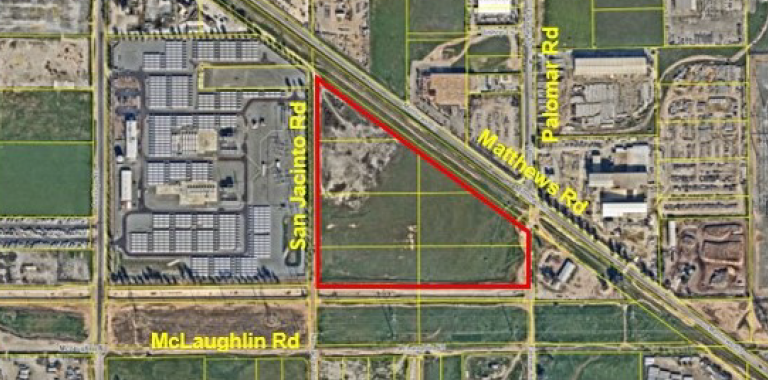
Map of the site location.
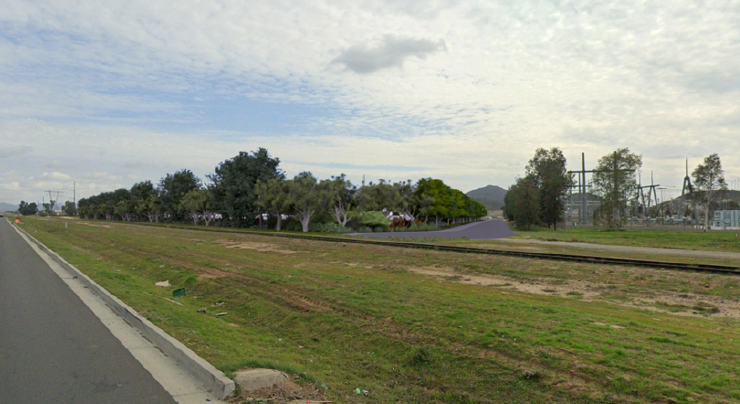
Street view of the site.